




The KALEIDOS project brought together researchers, innovation professionals, policymakers and representatives of European research ecosystems to explore how collaboration, Open Science and practical tools can turn research knowledge into real-world value. On 16 September 2026, the KALEIDOS project held its Final Conference, Knowledge Valorisation in Practice!, bringing together perspectives from universities, research organisations, public authorities and innovation initiatives to reflect on the future of Knowledge Valorisation in Europe.
From research excellence to societal impact
A central message of the conference was that excellent research does not automatically translate into societal impact. Knowledge Valorisation requires collaboration, new professional competences and institutional environments that enable knowledge to be shared, adapted and applied beyond academia. The event opened with contributions from Mireia Manent, KALEIDOS Project Coordinator at WeDo | Project Intelligence Made Easy, and Annamaria Zonno, Project Adviser at the European Research Executive Agency (REA), who introduced the broader European policy context for strengthening Knowledge Valorisation.
Throughout the programme, partners explored the systemic changes needed to support this transition, Begoña Miñarro Vivas (Universitat Autònoma de Barcelona), addressed the evolving roles and competences of researchers and research managers, while Eamonn McCallion (Karlstad University), highlighted the importance of effective facilitation in bringing together stakeholders with different perspectives, priorities and working cultures.
Their contributions reinforced the need to move beyond traditional, linear models of knowledge transfer towards more collaborative approaches involving academia, industry, public authorities and civil society.
The KALEIDOS Toolkit: turning knowledge into practice
One of the main outcomes presented during the conference was the KALEIDOS Knowledge Valorisation Best Practice Toolkit, developed to support universities and research organisations in strengthening their Knowledge Valorisation practices through Open Science.
The Toolkit brings together practical methodologies, training resources and assessment tools that organisations can use to understand their current capacities, identify opportunities for improvement and develop more collaborative approaches to research and innovation. Its resources support institutional strategic planning, stakeholder engagement, participatory challenge identification, the co-creation of research-based solutions and impact assessment. Designed as a flexible and adaptable resource, the Toolkit can be implemented as a complete process or explored through individual modules according to each organisation’s needs.
The conference also explored how these approaches have been tested and adapted in different research environments. Lydia Giménez-Llort (Universitat Autònoma de Barcelona), presented an example of connecting academic knowledge with citizens’ needs, while Aneta Andrzejczyk (Medical University of Łódź), shared insights from the institution’s experience as a KALEIDOS pilot site.
Policy recommendations and Impact Assessment for stronger Knowledge Valorisation ecosystems
Beyond practical tools, KALEIDOS has developed policy recommendations aimed at strengthening Knowledge Valorisation at three interconnected levels: universities, innovation ecosystems and the European Union. During the conference, Azzurra Meoli and Silvia Poli (University of Bologna) presented recommendations addressing institutional strategies, stakeholder collaboration, professional recognition and the conditions needed to support sustainable Knowledge Valorisation practices.
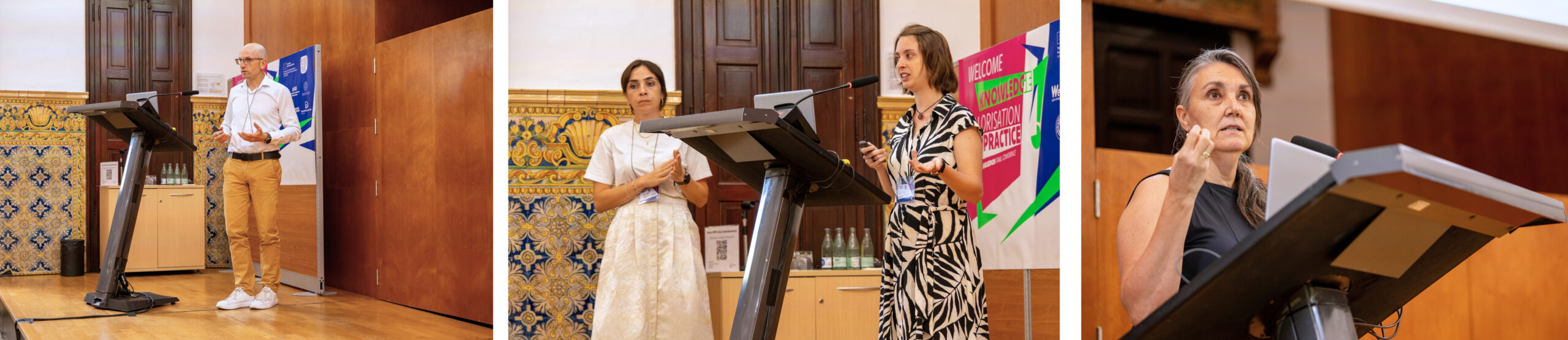
The programme also addressed how to assess the value generated through these activities, Davy Monticolo (University of Lorraine), presented approaches to measuring Knowledge Valorisation impact, recognising dimensions such as collaboration, skills development, Open Science and innovation.
Connecting European experiences and looking ahead
The conference also featured contributions from other European innovation initiatives, broadening the discussion beyond the KALEIDOS consortium. Presentations addressed connecting European innovation, Blue Ocean Strategy for value creation, and turning clinical innovation into patient benefit, illustrating different ways in which research and innovation can respond to real-world challenges.
The final roundtable, Knowledge Valorisation in Practice: Challenges & Lessons Learned, provided an opportunity to reflect on the practical conditions that enable collaboration, including stakeholder engagement, the development of professional competences and the translation of promising ideas into implementable solutions.
As KALEIDOS concludes, its methodologies, training materials, policy recommendations and digital Toolkit remain available to support research organisations and innovation actors interested in developing their own approaches to Knowledge Valorisation. The project’s final conference reinforced a key message: transforming research into value requires more than transferring results. It requires creating the conditions for people, knowledge and organisations to work together.